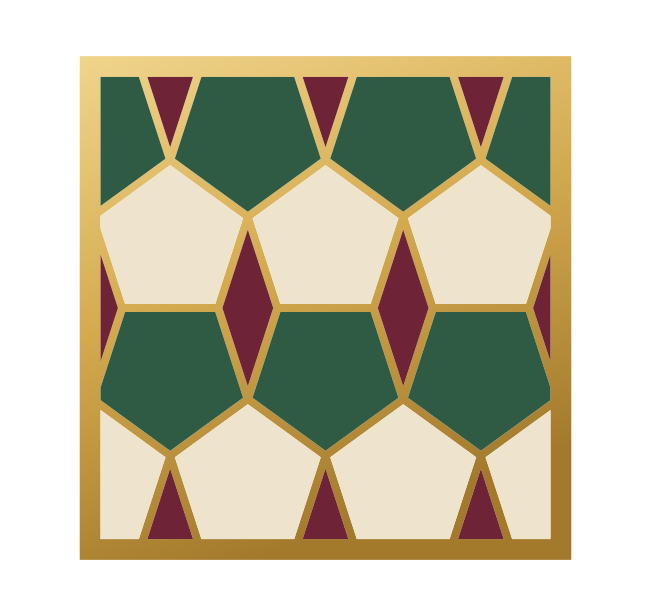
Dürer’s pentagons
Of the pentagon, Albrecht Dürer gives several floors in the second book of his Underweysung der Messung, printed in 1525. The first: three pentagons standing with their sides on a level line, touching at their corners, and below them three more set side to side against them, “so werden zwischen den fuenfecken”, so between the pentagons there come “ablang rauten firung”, long lozenges. Make that again, he goes on, and push two such strips together, the corners of the one into the angles of the other. He calls it “die gneuest zuosamen setzung der fuenfeck”, the closest setting together of the pentagons. It closes without a gap: two pentagons touching at their corners leave an angle of 108 degrees between them, a pentagon’s own angle, so the next strip’s pentagon fits into it point down, and every lozenge has the pentagon’s side, with angles of 36 and 144 degrees. Dürer does not say how to draw it, so the construction here is our own, and it is exact. On the given side a vesica raises the middle line, and the side run on is cut a side beyond its end. An upright raised there is cut a side above the end, and the circle about the middle of the side through that point cuts the line a diagonal from the far corner. From then on every corner is found by two swings, one at the side and one at the diagonal, from corners already found. The frame’s sides run through corners where pentagons touch, its top and foot along the bases of the outer strips. The three tones are ours.
Sources
- Albrecht Dürer, Underweysung der Messung, 1525, second book, figure 24
- Euclid, Elements I.1