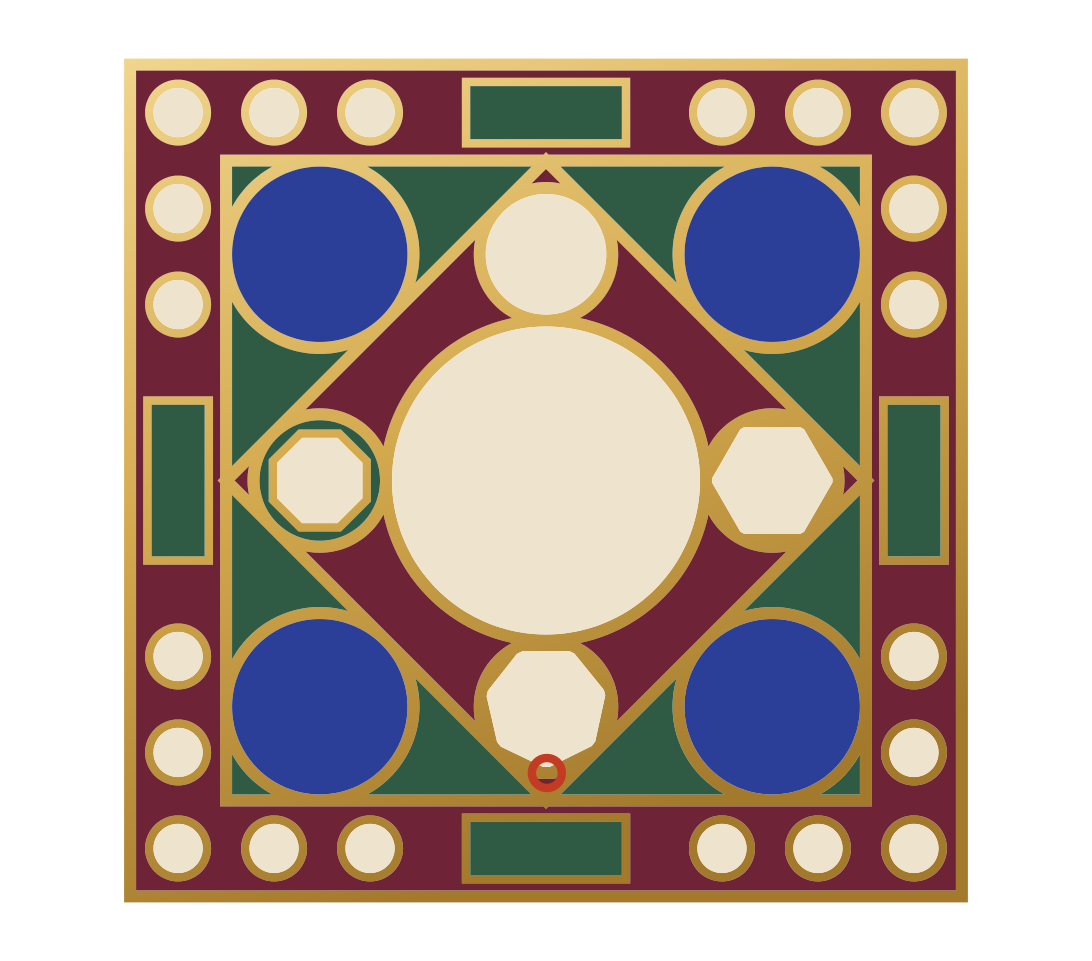
Cosmati quincunx
The great pavement before the High Altar of Westminster Abbey was laid in 1268 by order of Henry III. The workmen came from Rome, “with a man called Odoricus at their head”, and the floor is Cosmati work, after one of the families of craftsmen who specialised in it. The Abbey describes its design: “a broad border with a rectangle in the middle of each side and five roundels between each rectangle”, inside it “another square set transversely with its corners pointing north, south, east and west”, large roundels in the four spaces between the two, and in the turned square “a pattern known as a quincunx, with a large roundel in the very centre flanked by four roundels as if in orbit around the centre”. Of those four, “one is circular, one hexagonal, one heptagonal and one octagonal”. This plate draws that scheme. The infill patterns, all different, are left out, and the order of the four is ours. One circle carries the rest. Walked three times from its top at its own opening, it reaches the bottom; swings about top and bottom, opened to the second mark, cross on either side, and the line through them cuts the circle at the other two corners of the turned square. Swings at the first opening about those corners cross at the corners of the square around it, and its diagonals cut the circle at the centres of the corner roundels, each touching the border and the turned square. The circle through the middles of the turned square’s sides places the four orbits; the line through two of their centres runs on to where one touches a side, and that opening swings all four. The centre roundel, at half the first circle, touches each of them. The hexagon comes from two swings at the orbit’s own opening, the octagon from its square as the booklets cut it, each corner swung through the centre. The heptagon is stepped at half the side of the inscribed triangle, as in Seven will not close, and its seventh step falls short by 0.78 degrees, so the floor is approximate. The rectangles and small roundels of the border are set by eye.
Sources
- Dean and Chapter of Westminster, Cosmati Pavement, the Abbey’s history pages