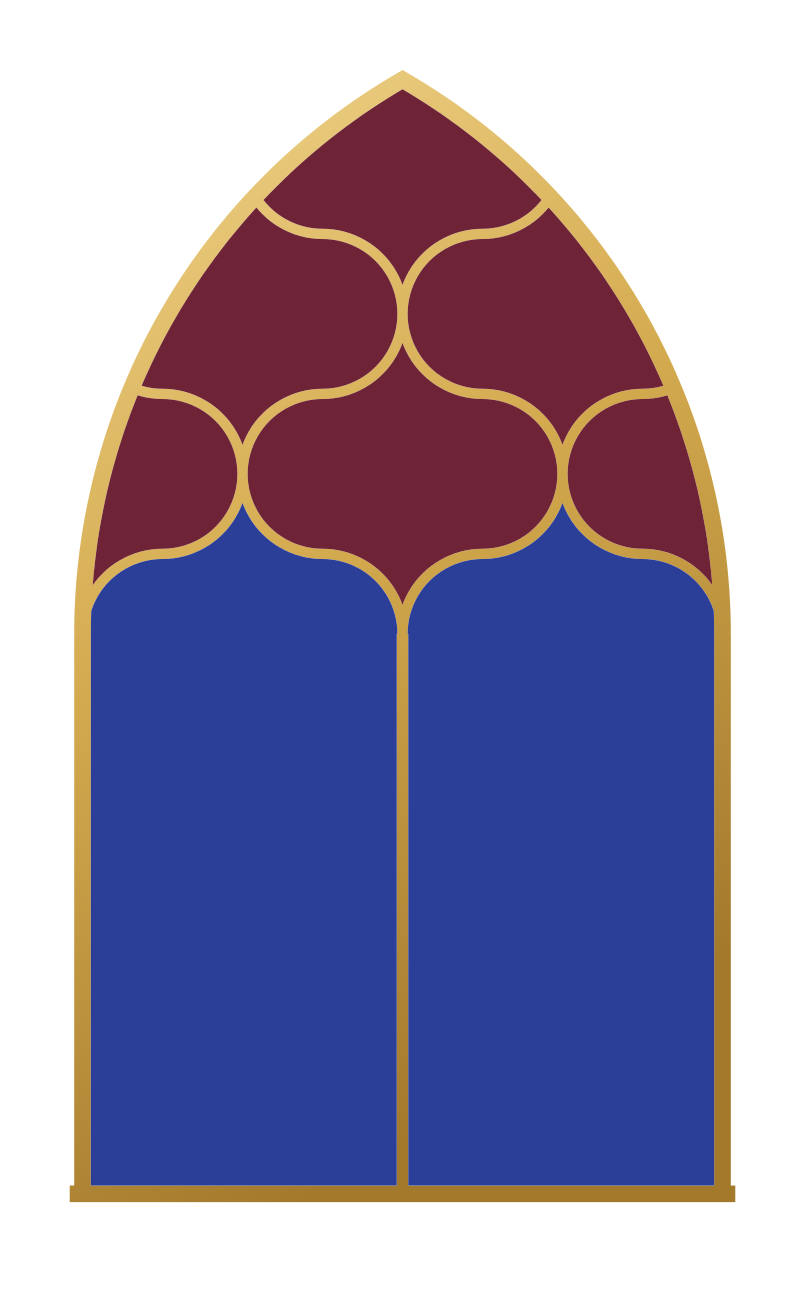
Reticulated tracery
Reticulated tracery fills a window head with a net: rows of ogees, each row set half a light over and half a span higher, so every opening between them is pointed above and below. John Henry Parker notes “a very fine window, with reticulated tracery” in the south walk of the cloisters at Westminster, which he dates to 1360. Windows of this kind, he writes, “are in general somewhat later than the geometrical patterns”, though “both classes may often be found side by side in the same building”. Parker gives no rule for drawing the net, so the construction here is our own, and it is exact. The head is equilateral on the span of both lights; its vesica gives the middle, and vesicas on the halves and quarters stand uprights a quarter of a light apart. On the outer two, half a light is stepped up from the springing, and the level lines through those marks cross every upright. Each crossing is a pin. About it, at a quarter of a light, a quarter circle bows out from a springing or turns in to a point, as in the ogee arch, and the net grows row by row until the head cuts it off.
Sources
- John Henry Parker, A B C of Gothic Architecture, 1881, pp. 137 and 139