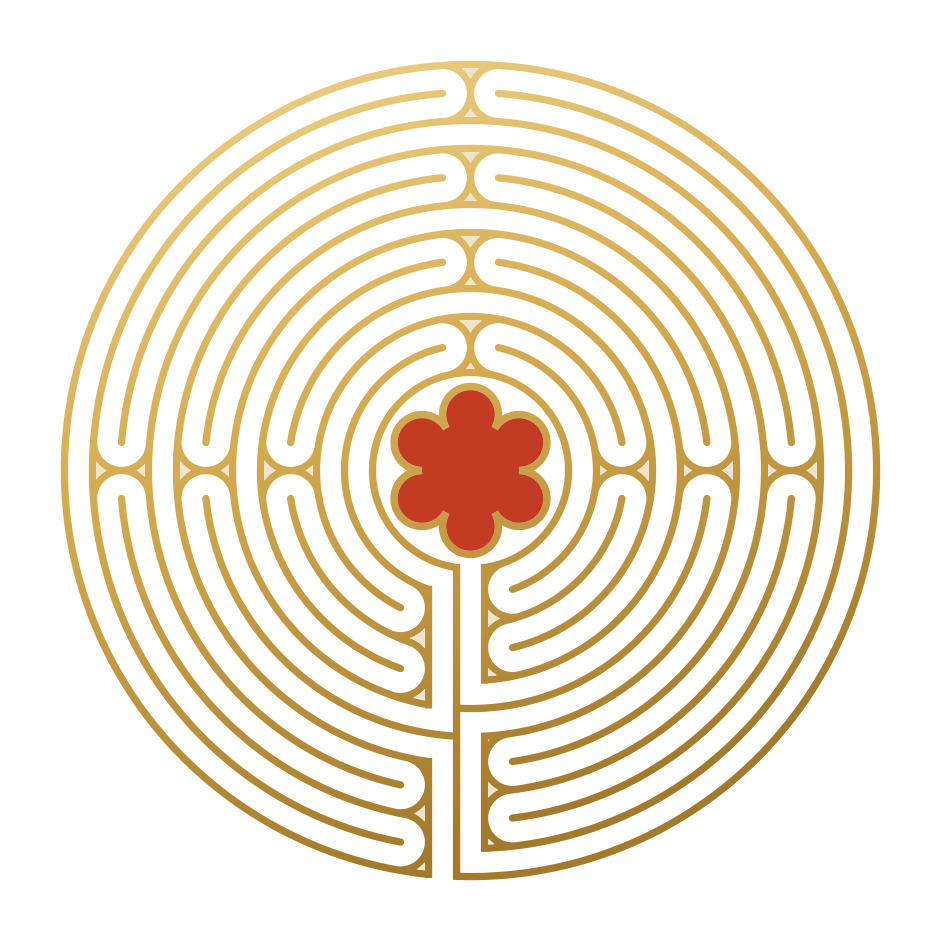
The labyrinth of Chartres
The labyrinth of Chartres lies across the whole width of the nave, between the third and fourth bays: a circle 12.89 metres across, with one path of 261.55 metres from the edge to the centre. Di Williams dates it to about 1201. The path runs through eleven circuits between twelve walls and never branches. It turns back only on four axes, and where two turns stand back to back, the walls leave small solid shapes between them. Willem Kuipers drew its course as a graph, circuit against step: “The quadrants are numbered clockwise, 1 to 4. The entrance is in quadrant 1, the centre is reached from quadrant 4.” Counted from the outside, the circuits come in this order: 5, 6, 11, 10, 9, 8, 7, 8, 9, 10, 11, 10, 9, 8, 7, 6, 5, 4, 3, 2, 1, 2, 3, 4, 5, 4, 3, 2, 1, 6, 7, and then the centre. Kuipers shows that the second half is the first turned about the sixth circuit, and finds the whole “very simple and elegant”. We know of no period rule for drawing it, so the construction here is our own, read against a plan of the floor, and it is exact. A short upright about the centre is given: the pitch, one path and one wall. Circles of the pitch about its ends give the level axis and the centre. About the centre follow circles of one and two pitches. Arcs of two pitches about the points where the larger crosses the axes mark the corners of two hexagons on it, and through the corners run level lines a pitch above and below the axis and, at the top, uprights a pitch either side of it. The walls are circles about the centre, from seven half pitches to twenty nine, each opening carried on from the last. On the entrance axis, every upright the turns and the runs need stands square to the level axis, through the crossings of two equal arcs about two points of that axis. Every turn is a half circle of one pitch about the end of a wall, where one of these lines crosses it. On the three side axes the turns stand back to back, a pitch either side. On the entrance axis they stand three half pitches to the right and five to the left, which leaves room between them for the two straight runs: the way in and the last way to the centre. In the centre, six lobes of one pitch about the corners of one hexagon touch one another and the first circle about the centre. The ring of small cusps round the rim is left out, since the sources count it differently.
Sources
- Bibliothèque nationale de France, Le labyrinthe de Chartres, as cited in Wikipedia (French), the article on Chartres Cathedral
- Di Williams, Labyrinth: Landscape of the Soul, as excerpted by the University of Edinburgh
- Willem Kuipers, Cadence Characterises Labyrinths, Caerdroia 31, 2000, pp. 33 to 40
- Plan of the labyrinth, Wikimedia Commons, ChartresApproximation.svg