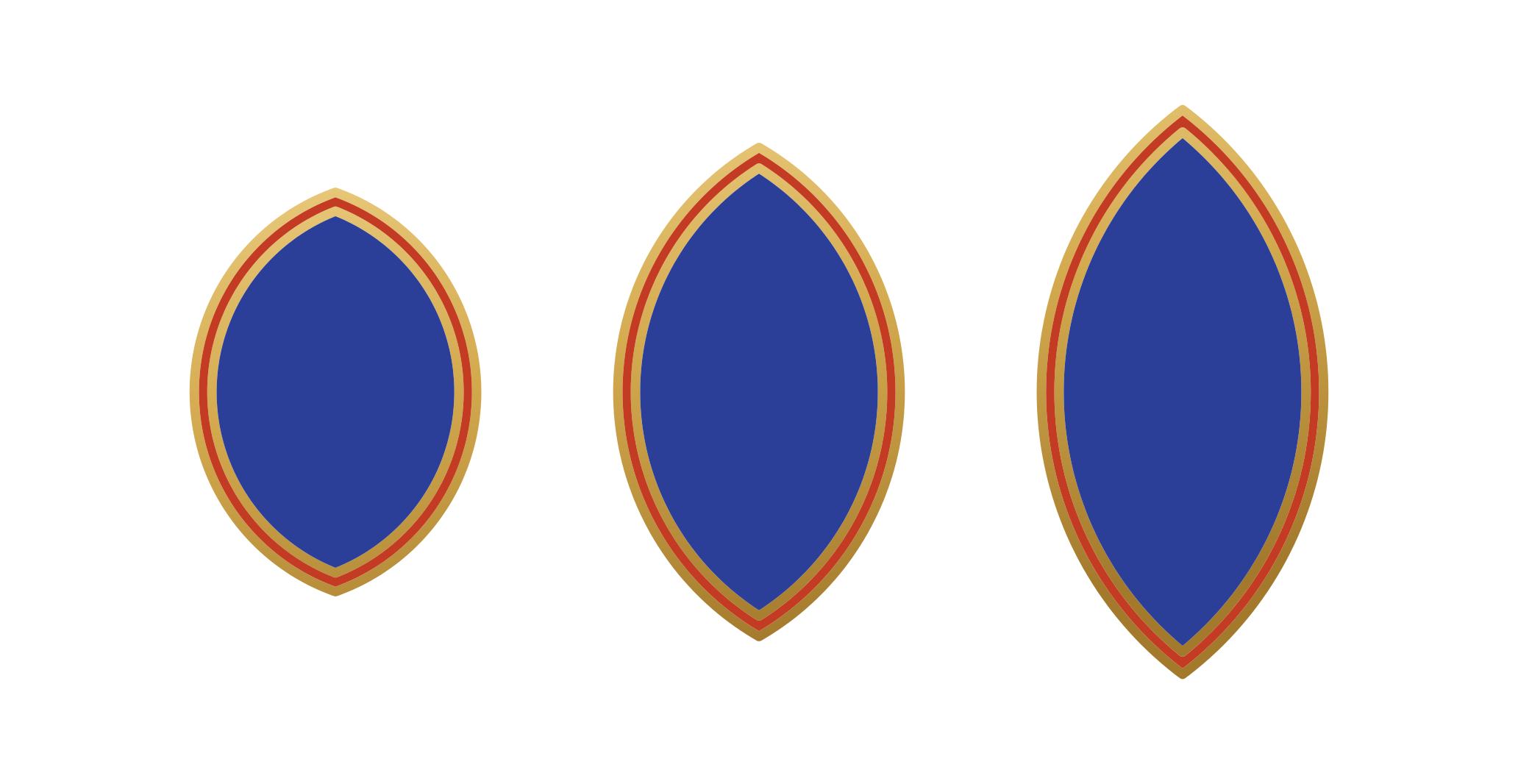
Three mandorlas
The mandorla is the almond of light drawn round a holy figure, and its plainest outline is the vesica of the first plate. Enikő Sipos writes on the technical study of the Hungarian coronation mantle begun in 1983; the mantle was first made as a bell chasuble. Its design, she finds, is set out from squares and circles by “a relatively simple practical method” with compass and ruler, and her drawing of it agreed with the embroidery to within half a centimetre to a centimetre. Its mandorlas are not all one shape. Their maker, she writes, set the centre of the circle that gives the arc sometimes inside the mandorla’s width point (the small mandorla), sometimes on it (the big mandorla) and sometimes beyond it (the shoulder mandorla), to suit the figure inside and its part in the whole. She does not say how far in or how far beyond, so those two positions here are ours: half way to the width point, and a quarter of the width beyond it. All three are drawn here on one width and framed as on the mantle. Their heights come out at 1.414, 1.732 and 2 widths; from the sizes Sipos measured on the mantle they are 1.42 to 1.46, 1.69 to 1.70 and 2.03. The big mandorla is drawn first, on the given width; its tips give the upright axis and the middle. Two swings of half the width cross on the line that halves the half width, and halving twice more gives the breadth of the frame, an eighth of the half width. The width is carried along the line to either side, half a width apart, and a swing of a quarter of the width about each width point marks the centres of the small mandorla on the left and of the shoulder mandorla on the right. Each frame is swung about the same centres with the opening shortened by its breadth.
In the faith
On the mantle the mandorla surrounds Christ: on the back he stands in one, and among the apostles he sits in another as the judge of the world (Sipos, p. 45).
Sources
- Enikő Sipos, Arányok és mértékek: A magyar koronázási palást struktúrája, Ars Decorativa 13, Budapest 1993, pp. 43 to 52