Straightening the circle
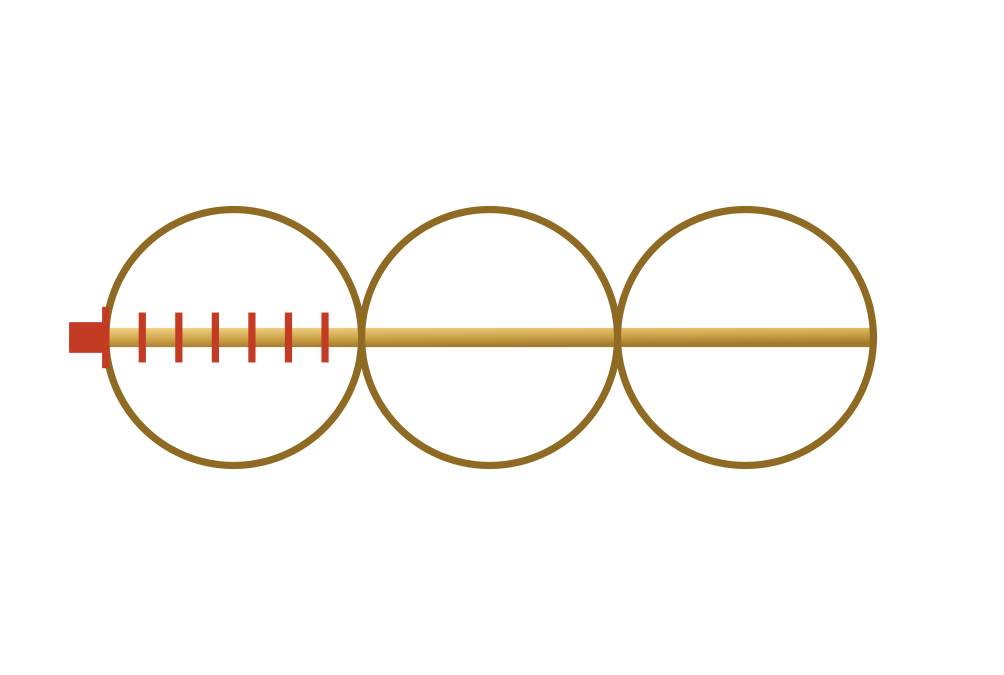
“Hernach so einer ein gerunden risz scheitreicht machen wil”: so the workshop booklet Geometria deutsch, attributed to Mathes Roriczer, begins laying a circle out straight. Draw three equal circles side by side on one line and divide the first diameter into seven equal parts. Set one part off behind the first circle: from there to the far side of the third, the booklet says, is as long as one circle’s round. That is three diameters and a seventh, the bound Archimedes proved the round stays under; so the line is 0.040 percent too long. Compass and straightedge can do no more than approach it: Lindemann proved in 1882 that they cannot lay the round of a circle out straight exactly. The booklet does not say how to divide in seven. Here two parallel rays carry one opening, set by eye, six times, and the lines joining them cut the diameter in sevenths.
Sources
- Geometria deutsch, attributed to Mathes Roriczer, about 1488
- Archimedes, Measurement of a Circle, Proposition 3
- Ferdinand Lindemann, Mathematische Annalen 20, 1882