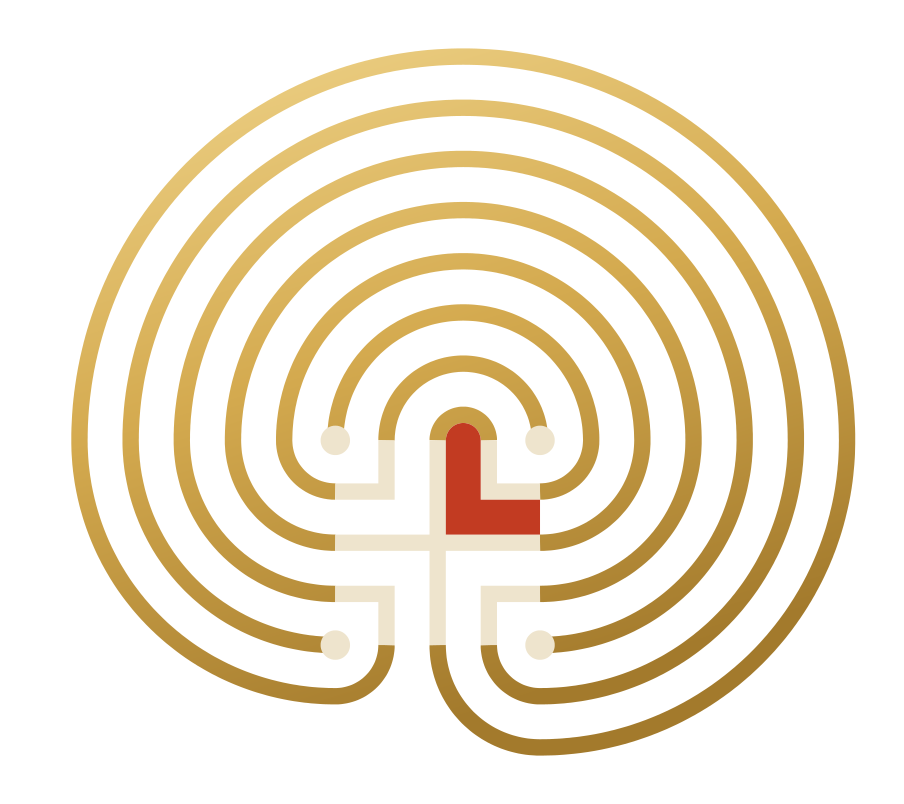
Labyrinth of seven circuits
The classical labyrinth is one path through seven circuits, with no branch on the way to its centre. Tony Phillips calls the way it is drawn “a kind of systematic doodle”: “start with a cross, four L’s and four dots”, then “join up the ends of the figure by arcs, beginning with a central pair and then always using the next two ends, one from each side.” The design is far older than the churches. After Hermann Kern, Phillips describes a clay tablet from the palace of King Nestor at Pylos, “hardened in the fire that destroyed the palace around 1200 BC”, with the labyrinth scratched on its back; the scratches suggest it “was drawn from its nucleus”, though its arcs are “squared off rather than rounded”. Kern finds the design standing for the Labyrinth on coins as early as 430 BC. Di Williams writes that toward the end of the ninth century a monk called Otfrid “took the classical seven circuit labyrinth pattern and added four extra circuits”, and that his drawing became the precedent for the labyrinths of the twelfth and thirteenth century churches. The most famous of them, at Chartres, was laid in the nave about 1201 and is still there. Here the arcs are drawn with the compass, and the figure is exact. The seed stands on a square of four units. A vesica on the upright of the cross gives its arm, the circle through the upright’s ends gives the arm’s length, and swings at that opening set the dots in the corners; vesicas on the sides give the angles. Every end of the seed lies on the square’s edge, sixteen in all. Each arc crosses the top as a half circle about one pin, midway between the head of the cross and the end beside it, and comes down the sides as quarter circles about the upper dots; the two outermost turn under the seed about the lower dots. Walked from the mouth, the path takes the circuits in the order three, two, one, four, seven, six, five, counted from the outside, and ends in the centre beside the cross.
Sources
- Tony Phillips, Drawing the Cretan maze as a game, Through Mazes to Mathematics, Stony Brook University, after Hermann Kern, Labyrinthe, 1983
- Hermann Kern, Through the Labyrinth, 2000, p. 54, as cited in Wikipedia, Labyrinth
- Di Williams, Labyrinth: Landscape of the Soul, as excerpted by the University of Edinburgh