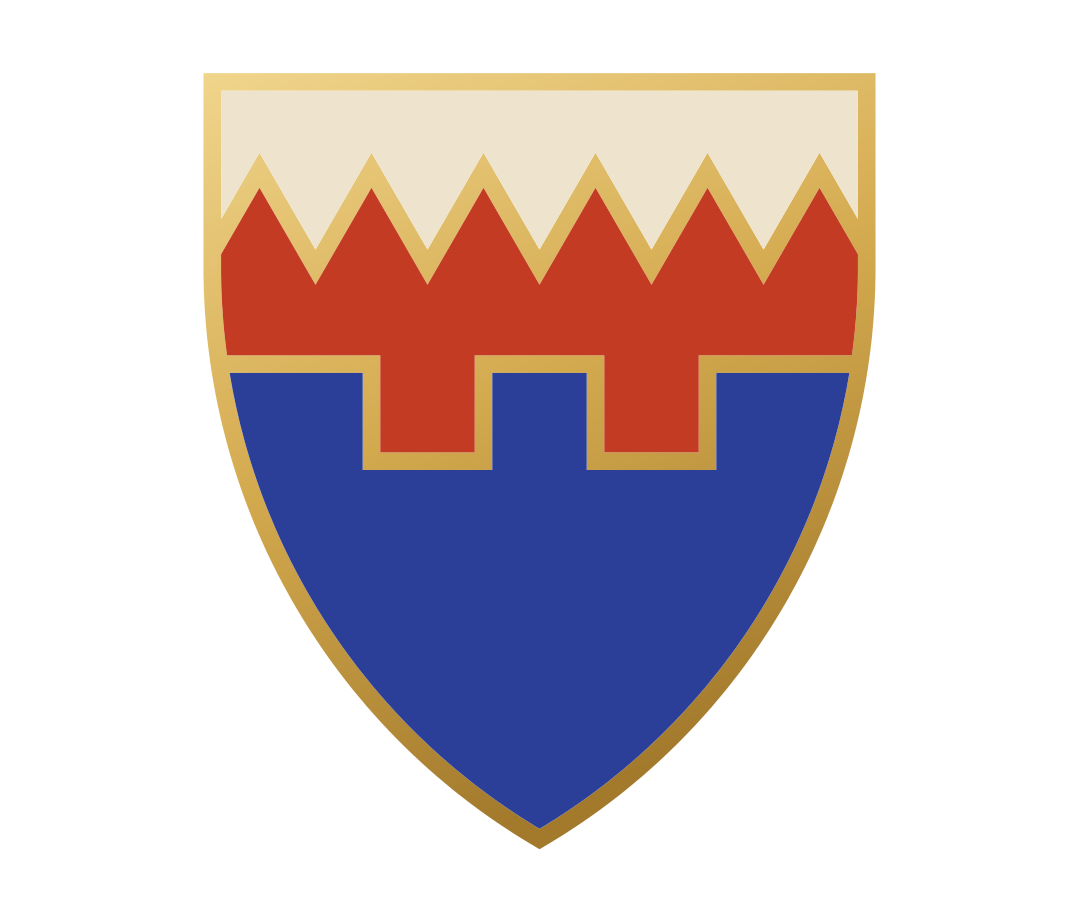
Lines of partition
Heraldry parts a field by lines and names their shapes. Writing for craftsmen in 1913, William St John Hope notes that the lower edge of a chief “was often indented like the edge of a saw; but in early heraldry engrailing and indenting were interchangeable terms”, and that fesses and bars “were occasionally battled, through the upper line being formed into battlements”. We know of no period rule for drawing these lines with compass and straightedge, so the construction here is our own, and it is exact. A chief indented stands over a field parted by an embattled line. One opening is set round a point and stepped along a line both ways, and every swing crosses its neighbours above and below the line. The indented line runs from each stepped point to the crossing above it: teeth of sixty degrees. Swings about two neighbouring crossings below the line meet again a row further down; the line through two such points, with the uprights through the crossings, gives the battlements, each one unit wide. The shield stands on the same stepping: the feet of its sides are six units apart, the sides rise to where swings of two units cross, and the flanks are swung at the width, each from the foot of the other side.
Sources
- W. H. St. John Hope, Heraldry for Craftsmen and Designers, 1913, p. 45