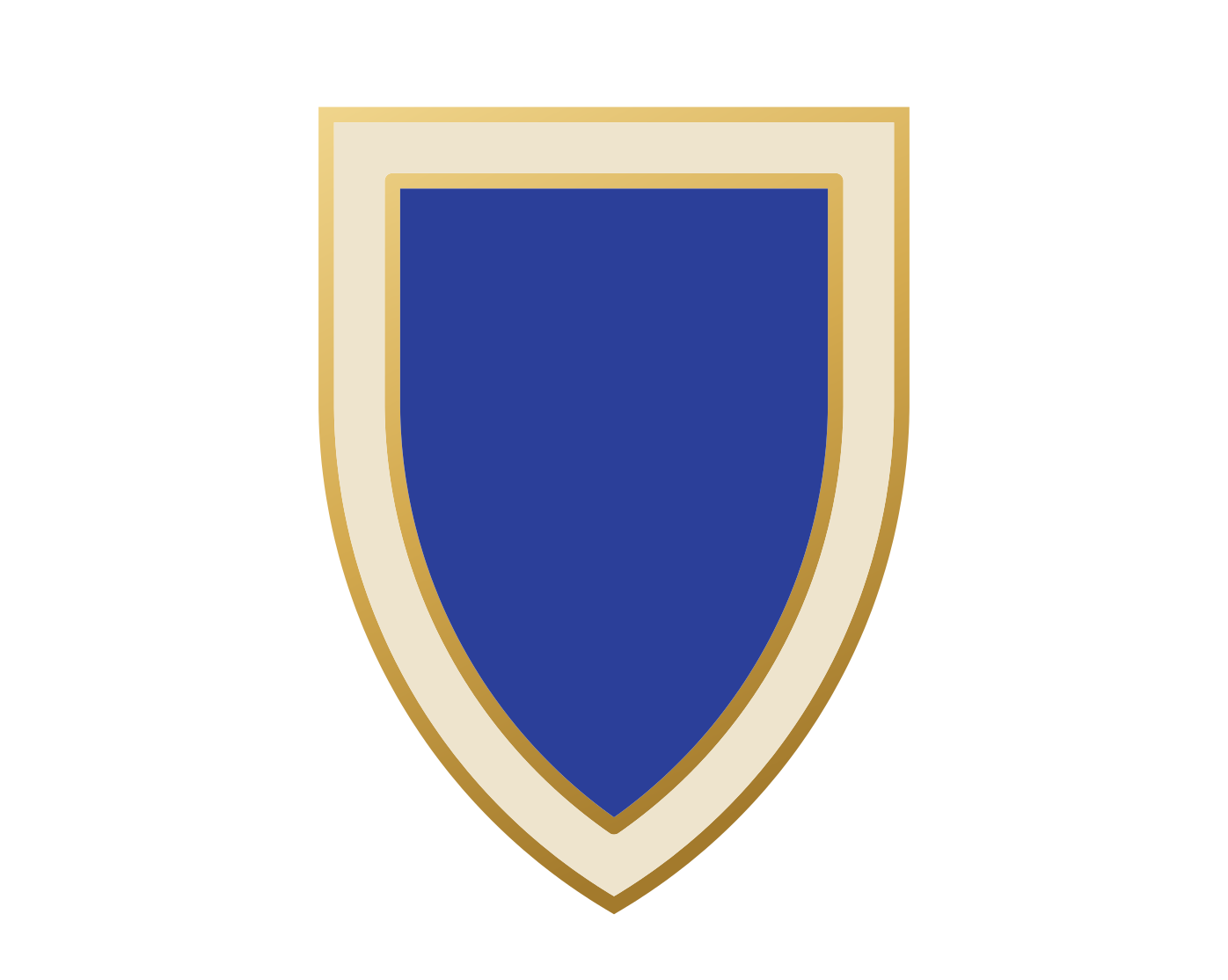
Border
Counting the pieces that the partings of a shield gave to heraldry, William St John Hope writes that “the border almost suggested itself.” It also told a son’s arms from his father’s: they were differenced by “adding to the paternal arms such more or less unobtrusive device as a label, or narrow border”. A border that bore no charge, Hope adds, “was drawn very narrow”. Here it is a border argent on a field of azure, an eighth of the width broad so that it reads at this size. Hope gives no rule for drawing it, so the construction here is our own, and it is exact. The shield is laid out as for gyronny, from a line down the middle as long as the shield is wide, so that the top edge, the sides and the level line through the middle make two squares. Their diagonals cross at the centres of the squares; the line through the two centres halves the sides, and a swing of half the side about the top of the middle line halves the top edge. A line from each half way point of the top edge down through the centre of its square meets the level line. A line from the same half way point to the half way point of the side below it cuts the diagonal from that corner: the inner corner of the border. Straight below it, a line from the side’s half way point to where the line through the centre meets the level line cuts the square’s other diagonal, and the inner side runs through the two points. The inner flanks are swung from the same feet as the shield’s own, the opening shortened by the border’s breadth, from where the inner sides cross the level line. So every part of the inner edge lies the same distance inside the outline.
Sources
- W. H. St. John Hope, Heraldry for Craftsmen and Designers, 1913, pp. 41, 85, 98 and 99